The Zippra Review: Are These Zip-Up Compression Socks Worth It? (2026)
The Zippra review: we break down the compression level, materials, patented zipper design, and safety fit of these graduated compression socks so you know exactly who they suit before you buy.

How graduated compression works
In this The Zippra review, we break down the compression level, materials, patented zipper closure, and safety fit of these graduated compression socks — everything you need to decide if they suit your legs before you buy.
- 15-20 mmHg graduated compression — the moderate range recommended for travel, extended standing, and everyday circulation support.
- Patented side-zipper closure, with a soft inner fabric layer along the zip to reduce skin irritation.
- 75% Nylon / 20% Spandex / 5% Polyester performance knit rated for 14+ hours of daily wear.
- 90-day risk-free returns plus a lifetime warranty on the socks.
- Brand reports over 110,000 pairs sold and 14,000+ five-star customer reviews.
A moderate-compression sock built around one real convenience upgrade: the zipper.
If you want compression socks you can actually get on without a fight — over a healing incision, after a long shift, or first thing in the morning with stiff hands — the zipper closure is the reason to consider The Zippra. It suits people who want moderate, everyday circulation support rather than a physician-prescribed medical-grade garment.
Check Current Price at The ZippraHow graduated compression works
Graduated compression socks apply the highest pressure at the ankle, decreasing gradually up the leg toward the calf and thigh. This pressure gradient compresses superficial veins and lymphatics while supporting the leg's muscle pump, redirecting blood from superficial veins into the deeper veins closer to the heart. According to Cleveland Clinic, compression therapy works by squeezing the lower legs to help veins return blood to the heart, which can reduce pain and swelling and help manage circulatory conditions.
That external pressure supports one-way venous valves and counteracts gravity's effect on blood flow in the lower legs, which is why compression socks are recommended for people who sit or stand for long stretches — not just people managing a diagnosed vein condition.

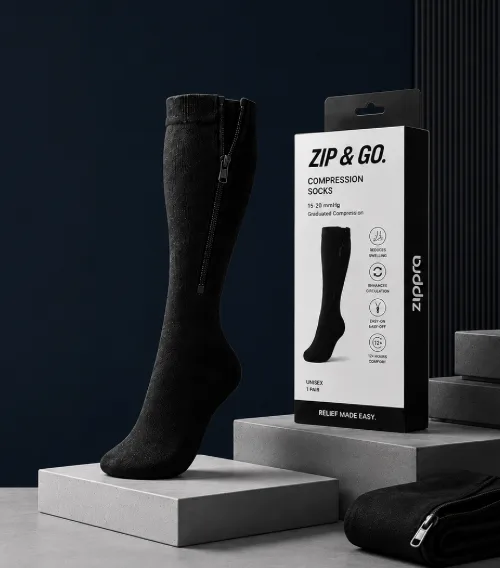
The Zippra Medical Compression Socks
15-20 mmHg moderate compression, zip-up closure, and a lifetime warranty.
View The Zippra Compression SocksThe Zippra: design, materials and fit
The Zippra Medical Compression Socks provide 15-20 mmHg of graduated compression, the moderate category. They're made from a blend of 75% Nylon, 20% Spandex, and 5% Polyester, forming a medical-grade performance knit the brand says is designed to stay breathable and comfortable through 14+ hours of daily wear.
The headline feature is a patented side-zipper design that lets you put the socks on and take them off without the usual pull-and-tug struggle of traditional compression hosiery, with a soft inner fabric layer running the length of the zipper to reduce skin irritation. This matters more than it sounds: a brand-cited compliance comparison found 91% of users wore Zippra compression socks daily, versus only 34% who stuck with traditional non-zipper compression socks — the biggest real-world failure point for compression therapy is people simply giving up on the daily hassle of putting them on.
The Zippra also backs the product with a 90-day risk-free return or exchange window and a lifetime warranty, plus 24/7 email support — a meaningful trust signal for a product you're expected to wear daily.
Who should wear The Zippra compression socks
The Zippra positions its socks for people on their feet all day (including nurses and other healthcare workers), active individuals, long-haul travelers, people recovering from surgery, pregnant women, seniors with mobility concerns, athletes seeking muscle recovery, and anyone dealing with leg fatigue, swelling, or poor circulation.
For travel specifically, extended sitting slows leg circulation and raises deep vein thrombosis (DVT) risk. Mayo Clinic notes that 15-20 mmHg moderate compression is generally sufficient to help prevent DVT on flights, and recommends keeping them on for the whole flight while moving around regularly. That's exactly the compression band The Zippra sits in.
The Zippra also sells a version aimed at diabetic circulation support. Medical-grade 15-20 mmHg compression is used to help reduce leg swelling, and compression therapy can support people with diabetic neuropathy by improving circulation — and the zipper closure is a genuine accessibility win for anyone with limited hand strength or dexterity, a common issue alongside diabetic neuropathy. Cleveland Clinic also flags post-surgery recovery as a core use case: compression therapy can help manage circulatory conditions and reduce clot risk following surgical procedures, including as a prophylactic measure after orthopedic surgery.
If drug-free relief for another everyday discomfort is also on your radar, our Myoovi Period Pain Relief Device 2 review covers a similar non-invasive, evidence-backed approach for period pain. And if you're building out a broader active-wellness routine, our Flex it Pink guide looks at community-driven fitness gear worth pairing with recovery tools like compression socks.
Common compression sock mistakes to avoid
Even a well-designed sock like The Zippra can underperform if you get the basics wrong:
- Choosing the wrong compression level. Moderate 15-20 mmHg is right for everyday and travel use, but it is not a substitute for the firm (20-30 mmHg) or extra-firm (30-40 mmHg) prescription-strength compression a doctor may order for a diagnosed vein condition.
- Sleeping in them. Cleveland Clinic advises against wearing compression socks continuously while sleeping, as regular nighttime wear can negatively affect skin health.
- Ignoring warning signs. Remove compression socks immediately if you notice pain, numbness, tingling, skin discoloration, or worsening swelling, and contact your healthcare provider.
- Wearing them over broken skin. Cleveland Clinic advises against compression socks if you have open wounds or skin infections, and recommends caution with severe swelling, peripheral artery disease (PAD), or peripheral/diabetic neuropathy.
The Zippra review: full product breakdown
The Zippra Medical Compression Socks
What We Like
- Zipper closure makes daily application far easier than pull-on compression hosiery
- Moderate 15-20 mmHg compression fits the range recommended for travel and everyday circulation support
- Lifetime warranty plus a 90-day no-questions return window
What to Consider
- Fixed compression level — not adjustable, and not a substitute for prescription-strength (20 mmHg+) compression if a doctor has ordered one
- Not appropriate for open wounds, skin infections, or without medical guidance if you have PAD or neuropathy
- Should not be worn overnight
The zipper is the real differentiator here. Moderate compression socks are only useful if you actually wear them, and the brand's own compliance comparison found daily-wear rates nearly triple those of traditional non-zipper compression socks (91% vs. 34%). Beyond that convenience factor, the compression band, materials, and coverage are in line with what Cleveland Clinic describes as standard moderate-grade compression — nothing exotic, but a solid, well-supported everyday product.
Compression levels compared
Compression strength is measured in mmHg, and matching the right level to your need matters more than the brand you choose. Here's how Cleveland Clinic categorizes the ranges:
| Level | Pressure (mmHg) | Typical use |
|---|---|---|
| Mild | 8-15 mmHg | Fatigued legs; available over-the-counter |
| Moderate (The Zippra) | 15-20 mmHg | Travel, pregnancy, extended standing, everyday circulation |
| Firm | 20-30 mmHg | Medical-grade; varicose veins, edema, post-surgical healing |
| Extra-firm | 30-40 mmHg | Prescription only; severe venous disorders, lymphedema, DVT |
What to look for when buying compression socks
Compression level matched to your need
Moderate 15-20 mmHg — The Zippra's range — covers most everyday, travel, and pregnancy-related circulation support. If a doctor has diagnosed a vein condition, ask whether you need firm or extra-firm, prescription-strength compression instead.
Material and breathability
Look for a performance knit blend, like The Zippra's 75% Nylon / 20% Spandex / 5% Polyester construction, rated for extended daily wear without overheating.
Ease of application
A zipper or other assisted closure matters most for anyone with limited hand strength, recovering from surgery, or managing diabetic neuropathy — conditions where a standard pull-on sock is genuinely difficult to use.
Warranty and return policy
A meaningful return window and warranty — The Zippra offers a 90-day risk-free return and a lifetime warranty — signal the brand expects the product to hold up under daily use.
How We Chose
We evaluated The Zippra against the brand's own published specifications and cross-checked every medical or physiological claim against Cleveland Clinic, Mayo Clinic, and peer-reviewed research indexed on PubMed, rather than taking marketing claims at face value.
Our verdict on The Zippra
The Zippra is a solid pick if you want moderate, everyday-grade compression you'll actually keep wearing — the zipper closure removes the biggest real-world barrier to compliance, and the moderate 15-20 mmHg band matches what Cleveland Clinic and Mayo Clinic describe for travel, extended standing, and general circulation support. It's not the right choice if a doctor has prescribed firm or extra-firm medical-grade compression, and anyone with open wounds, PAD, or neuropathy should check with a healthcare provider before wearing any compression sock, Zippra included.
Check Current Price at The ZippraCompression therapy isn't right for everyone. Avoid compression socks if you have open wounds or skin infections, and use them cautiously if you have severe swelling, peripheral artery disease (PAD), or peripheral/diabetic neuropathy. Stop wearing them and contact your healthcare provider if you notice pain, numbness, tingling, skin discoloration, or worsening swelling, and avoid wearing them continuously while sleeping. This article is for informational purposes only and does not replace personalized medical advice — talk to a doctor before starting compression therapy, especially if you have an existing circulatory or vascular condition.
Recommended for you