Bite Toothpaste Bits Review: Are Plastic-Free Tablets Worth It?
An evidence-led Bite Toothpaste Bits review: what's in the fluoride and fluoride-free tablets, what the ADA and peer-reviewed studies actually say about nano-hydroxyapatite, and who should choose each formula.
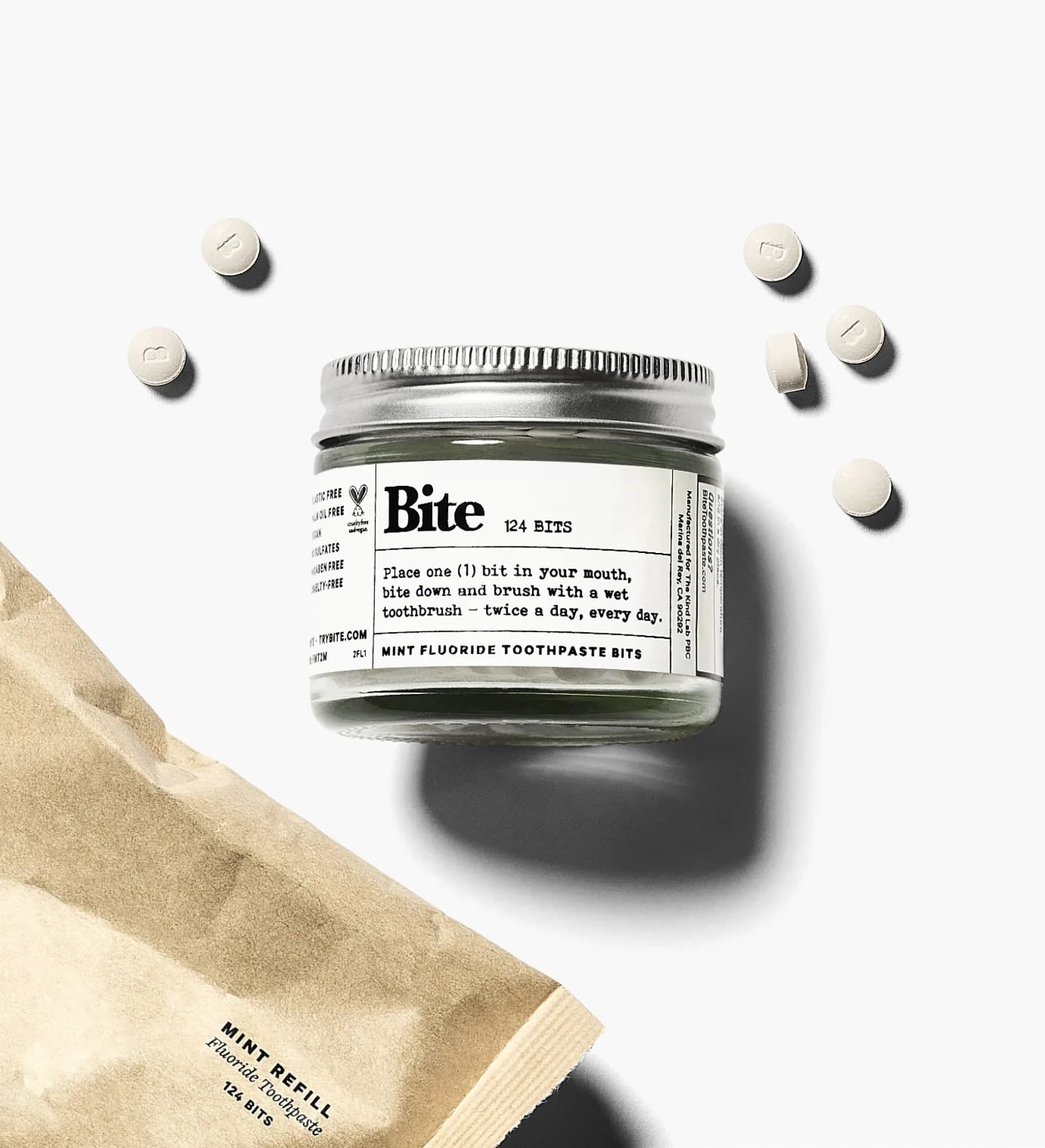
What's inside Bite Toothpaste Bits
This Bite Toothpaste Bits review answers the question most shoppers actually have before they buy: do plastic-free chewable tablets clean as well as a tube, and is the fluoride-free version safe to rely on long-term? Bite (The Kind Lab PBC) sells its Toothpaste Bits in refillable glass jars, in two active-ingredient lines — a fluoride formula and a nano-hydroxyapatite (nHA) fluoride-free formula — plus a wider zero-waste oral-care range.
Key Highlights
- Bite sells two active formulas — 0.76% sodium monofluorophosphate fluoride, and a fluoride-free nano-hydroxyapatite tablet — in refillable glass jars with compostable refill pouches.
- The fluoride formula's 0.76% sodium monofluorophosphate concentration matches the ADA-recognized therapeutic dose for cavity prevention.
- Nano-hydroxyapatite alone cannot earn the ADA Seal of Acceptance; the ADA still considers fluoride the standard for cavity prevention.
- No peer-reviewed clinical trial has tested Bite Toothpaste Bits as a finished product — the evidence backs the individual active ingredients.
- Bite is B Corp certified with an 87.8 B Impact score, and its products are cruelty-free, vegan, and palm-oil-free.
A well-formulated, genuinely plastic-free tablet — but choose the fluoride variant if you're prone to cavities
Bite's actives are individually well-studied, but the tablet format only performs as well as your chewing technique. If cavity prevention is your top priority, the fluoride bits are the more evidence-aligned pick.
See Bite Toothpaste BitsWhat's inside Bite Toothpaste Bits
Bite makes two active-ingredient lines. The fluoride formula uses sodium monofluorophosphate at 0.76% (0.14% w/w fluoride ion), combined with calcium carbonate, silicon dioxide, guar gum, xylitol, and zinc citrate. The fluoride-free formula swaps fluoride for nano-hydroxyapatite, alongside xylitol, erythritol, calcium carbonate, and zinc citrate, in mint, mint charcoal, and berry flavors.
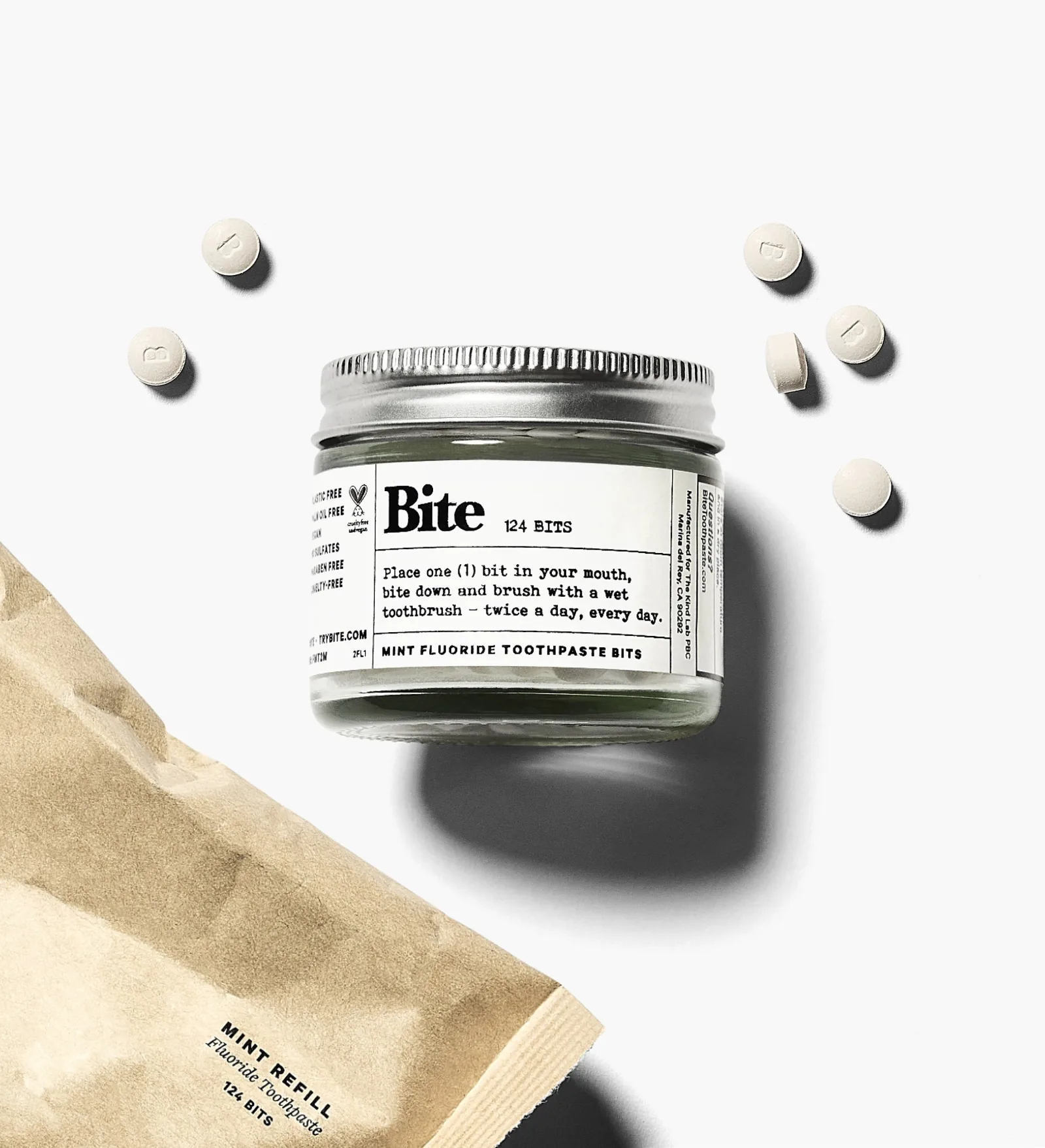
Both formulas rely on xylitol, which peer-reviewed literature links to reduced plaque-forming bacteria and lower acidity in the mouth, and zinc citrate, a well-established antimicrobial and anti-plaque ingredient in dental formulations. Packaging-wise, bits arrive in refillable glass jars with aluminum lids, and refill pouches are compostable FSC-certified material designed to break down in home compost within 12–16 weeks. Bite is also B Corp certified with an 87.8 B Impact score, and certified cruelty-free, vegan, and palm-oil-free.
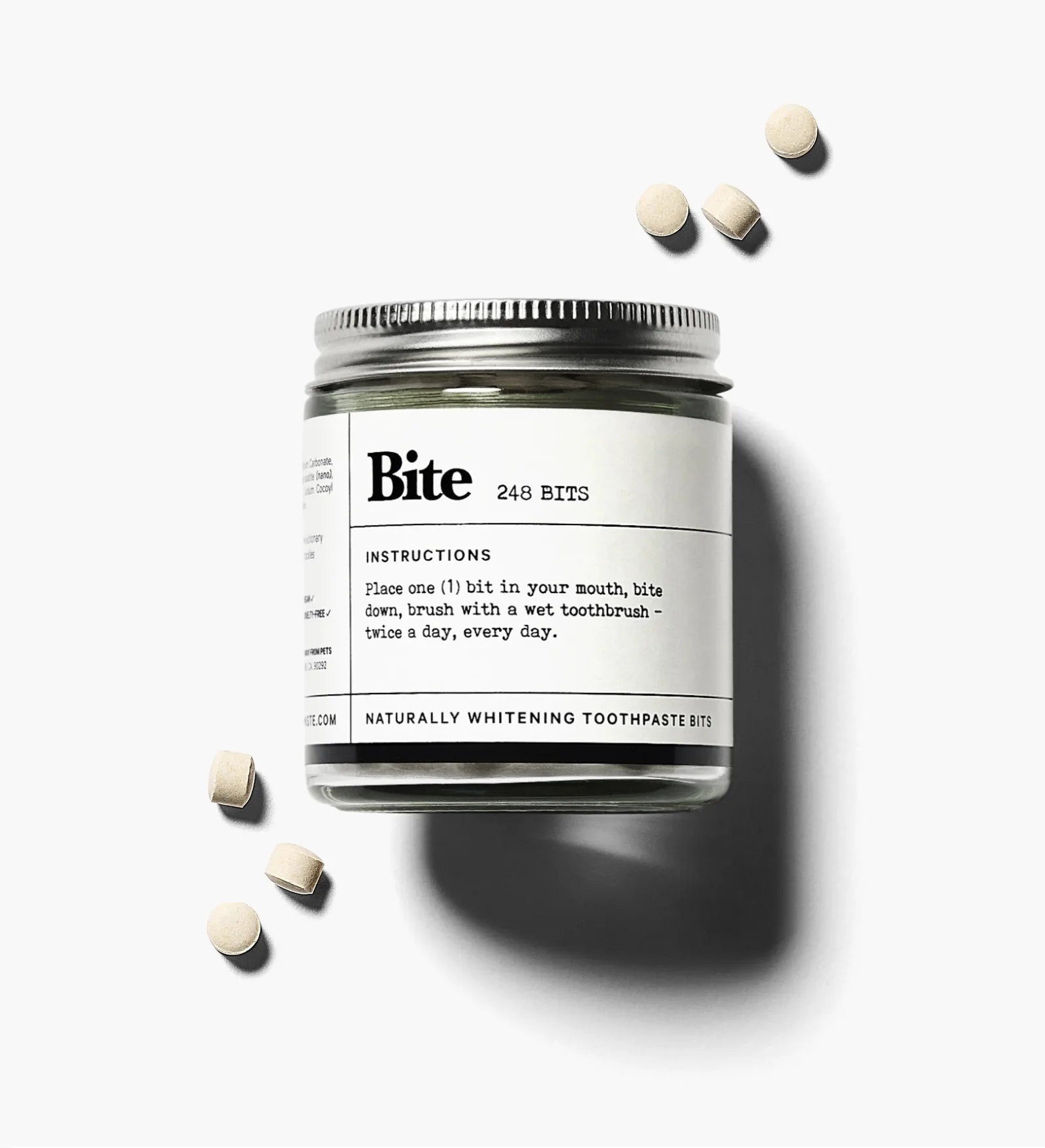
Bite Fluoride-Free Toothpaste Bits (Nano-Hydroxyapatite)
A glass-jar tablet built around nano-hydroxyapatite, xylitol, and zinc citrate — best suited to low-to-average caries risk after a conversation with your dentist.
Check the Fluoride-Free FormulaBite Toothpaste Bits review: the fluoride question
This is the part of any Bite Toothpaste Bits review that matters most. According to the Journal of the American Dental Association (JADA, 2025), fluoride remains the professional standard for cavity prevention, and toothpaste containing nano-hydroxyapatite alone cannot earn the ADA Seal of Acceptance under current standards. ADA consumer advisor Dr. Ada Cooper notes that while nano-hydroxyapatite is a synthetic calcium phosphate that mimics natural enamel structure, evidence for its cavity-prevention efficacy remains preliminary, and the ADA does not recommend replacing fluoride toothpaste with hydroxyapatite-only formulas as standard practice.
That doesn't mean nHA has no support. A 2025 systematic review and a triple-blind randomized clinical trial of 610 children aged 4–7 found that hydroxyapatite combined with fluoride produced higher inactivation rates of active caries lesions than fluoride alone in primary dentition. That is evidence for nHA-plus-fluoride, not for nHA replacing fluoride — a distinction worth holding onto when you compare Bite's two tablets. JADA's 2025 guidance also supports dentists offering hydroxyapatite alternatives specifically to patients who have already decided to decline fluoride, provided their oral health is monitored.
For readers with a higher caries risk — a history of multiple cavities, dry mouth, enamel erosion, or a condition affecting saliva flow — peer-reviewed format-comparison research recommends prioritizing a fluoride-containing formulation, tablet or paste, with established clinical validation. Bite's fluoride bits meet that threshold at the labelled 0.76% sodium monofluorophosphate concentration; the fluoride-free bits are better reserved for lower-risk users who've discussed the trade-off with a dentist.
One more honest caveat: no comprehensive clinical trial specifically validating Bite Toothpaste Bits as a finished product has been published in a peer-reviewed journal. The supporting evidence covers the individual active ingredients — nano-hydroxyapatite, fluoride, xylitol, zinc citrate — not the branded tablet itself. That's a limitation shared by most consumer oral-care brands, but it's worth stating plainly rather than implying brand-level clinical proof that doesn't exist.
How to use toothpaste tablets correctly
Format doesn't replace ingredients. Clinical research shows that plaque-removing efficacy and caries prevention depend primarily on the active ingredients — fluoride, nano-hydroxyapatite, xylitol — not on whether the product is a paste, powder, or tablet. Tablets are not clinically superior to paste for remineralization, but they do offer real convenience benefits: less packaging waste, easier travel, a longer shelf life, and lower abrasivity than many powders, without needing preservatives.
- Pop one Bite tablet and bite down until it fully breaks apart.
- Chew thoroughly until it forms a soft, toothpaste-like paste — this step is non-negotiable for even ingredient distribution.
- Wet your brush and brush as normal, for the full two minutes.
- Rinse as usual; incomplete chewing is the most common reason tablets underperform paste.
Distribution and contact time with teeth can vary based on chewing technique and saliva flow, so rushing the chew is the single biggest way to undercut a tablet's performance versus a paste you simply squeeze on.
Common mistakes with tablet toothpaste
Most disappointment with toothpaste tablets traces back to a handful of avoidable errors, not the format itself.
- Not chewing long enough. Toothpaste bits are only clinically equivalent to paste formulations when the user chews thoroughly until a soft paste forms before brushing; incomplete dissolution or uneven distribution can compromise efficacy.
- Choosing fluoride-free with a high caries risk. If you have a history of cavities, dry mouth, or a condition affecting saliva, the fluoride-free tablet is the wrong default — pick the fluoride formula or talk to your dentist first.
- Expecting whitening results. Whitening claims are the weakest-supported use case in the current nHA literature — treat any brightening as a bonus, not the reason to switch.
- Judging texture too quickly. Tablet mechanical properties — strength, friability, foaming — vary by formulation and compression, and some users find tablets grittier or less foamy than paste; this affects feel, not necessarily cleaning efficacy if your technique is sound.
Bite's oral-care lineup
Beyond the two toothpaste formulas, Bite extends the same glass-jar, tablet-first approach across a small oral-care range, which is useful context if you're building out a full plastic-free routine rather than swapping one product.
Bite Toothpaste Bits with Fluoride
What We Like
- Fluoride concentration matches the ADA-recognized therapeutic dose
- Plastic-free glass-and-compost packaging system
- Also contains xylitol and zinc citrate for plaque support
What to Consider
- No published clinical trial on the finished tablet itself
- Tablet texture can feel grittier than a paste
For readers focused on cavity prevention first and sustainability second, this is the formula that aligns with current ADA guidance without asking you to compromise.
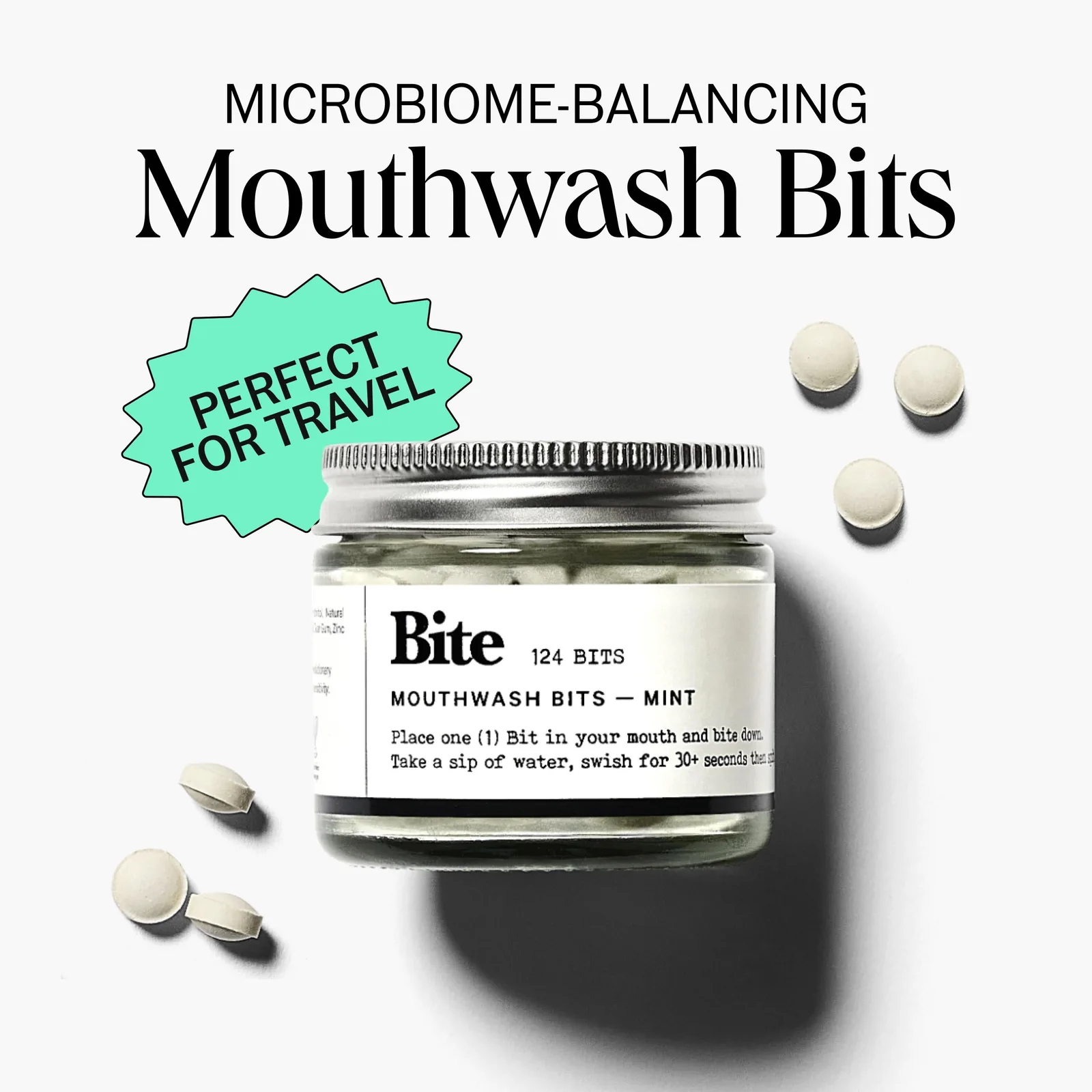
Bite Mouthwash Bits
What We Like
- Same zero-waste tablet system as the toothpaste bits
- Xylitol content aligns with peer-reviewed plaque-reduction evidence
What to Consider
- Fluoride-free by default — not a substitute for a fluoride rinse if that's what your dentist recommends
Useful as a complementary step rather than a replacement for brushing, and it keeps the entire routine plastic-free.
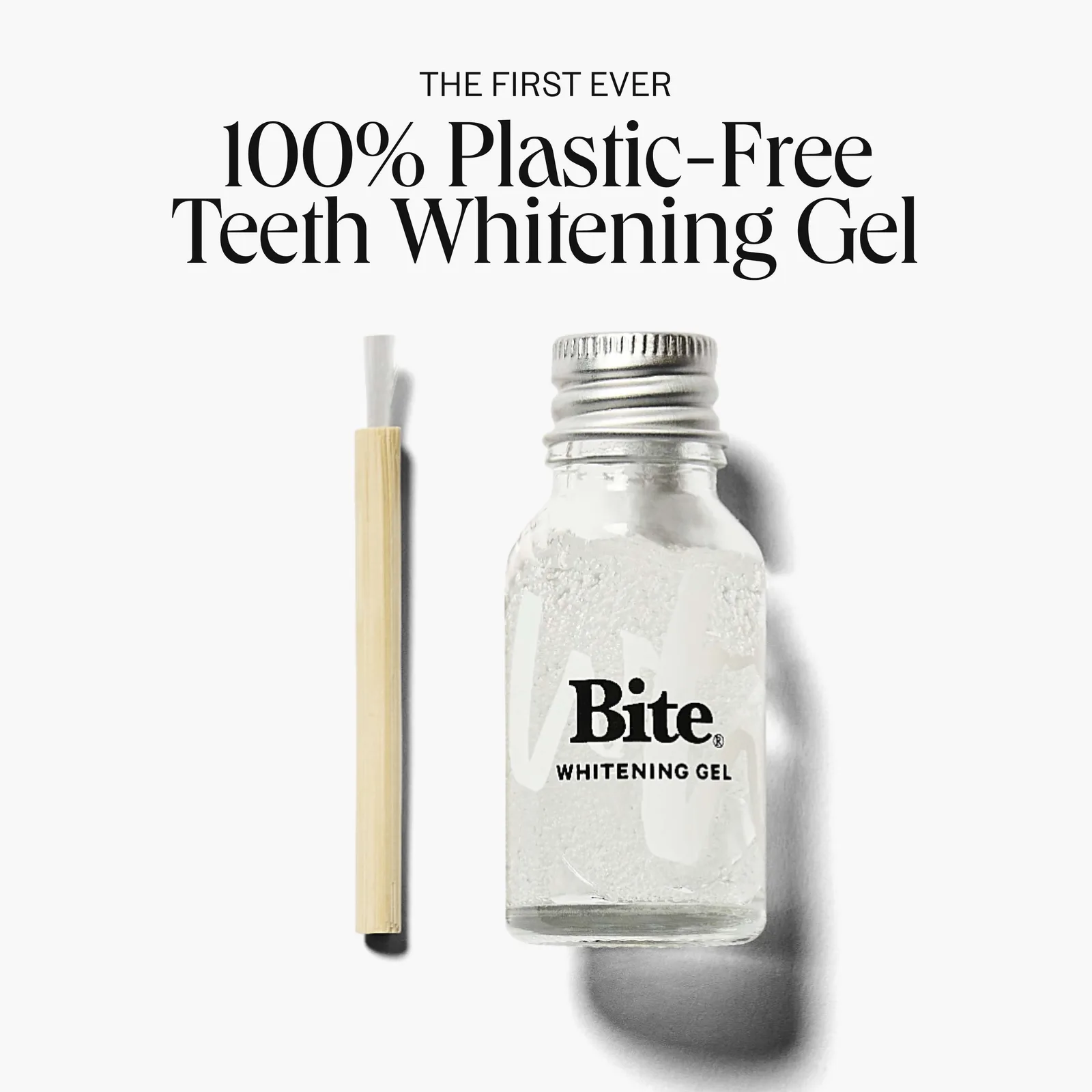
Consider pairing Bite with zero-waste deodorants and personal care for a fully plastic-free routine. Bite's range also includes a Whitening Gel, a bamboo Toothbrush, Floss, a Tongue Scraper, and a Deodorant line in Neroli, Rose Vert, and Santal scents — all built around the same refill-first packaging model. None of these carry independent clinical trials either; treat them as sustainability-driven purchases, not clinically proven treatments.
Fluoride vs. fluoride-free vs. paste
| Factor | Bite Fluoride Bits | Bite Fluoride-Free Bits | Standard fluoride paste |
|---|---|---|---|
| Active ingredient | Sodium monofluorophosphate 0.76% | Nano-hydroxyapatite | Sodium fluoride or SMFP, typically 1000–1500 ppm |
| ADA Seal eligible | Formula matches ADA therapeutic concentration | No — nHA-only formulas cannot earn the ADA Seal | Yes, when independently tested and submitted |
| Best-suited caries risk | Average to higher risk | Low to average risk, dentist-discussed | Any risk level |
| Packaging | Glass jar + compostable refill pouch | Glass jar + compostable refill pouch | Typically plastic tube |
| Format-specific superiority | Not clinically superior to paste — depends on chewing technique | Not clinically superior to paste — depends on chewing technique | Familiar dosing, no chewing step required |
What to look for before you switch
Not every reader who wants plastic-free oral care needs the same tablet. Match the formula to your actual risk profile rather than the marketing angle.
If you have a history of cavities or dry mouth
Choose the fluoride formula. The ADA does not recommend replacing fluoride toothpaste with hydroxyapatite-only formulas as standard practice, and this is the group the guidance is most protective of. If you've already discussed dropping fluoride with a dentist for a specific reason, that conversation — not a marketing claim — should decide the switch. If mouth dryness itself is a recurring issue, a broader read on nightly habits linked to dry mouth may help alongside your toothpaste choice.
If you're low-risk and prioritize sustainability
The fluoride-free nano-hydroxyapatite formula is a reasonable choice, especially paired with good chewing technique and routine dental checkups. Combining nHA with fluoride showed the strongest results in the 2025 pediatric RCT, so some adults alternate or ask their dentist about a hybrid routine rather than treating the two as mutually exclusive.
If you're comparing tablet brands generally
Look past the format and check the active ingredient list first — efficacy is ingredient-driven, not format-driven. A tablet with no fluoride and no nHA is not doing the same job as either Bite formula, regardless of how it's packaged. If you're weighing tablets against an electric-brush upgrade instead, our Autobrush review covers a different angle on the same daily routine.
How We Chose
We built this review from Bite's own ingredient and packaging disclosures, the ADA/JADA's 2025 professional guidance on fluoride versus nano-hydroxyapatite, and peer-reviewed studies on each active ingredient and on toothpaste-tablet formulation generally. We did not run our own clinical testing and say so explicitly wherever the evidence stops at the ingredient level rather than the finished product.
Final verdict
Bite Toothpaste Bits are a genuinely plastic-free, well-formulated tablet — but this Bite Toothpaste Bits review lands on a risk-based recommendation rather than a single universal pick. Choose the fluoride formula if cavity prevention is your priority or if you have any history of decay, dry mouth, or reduced saliva flow; its 0.76% sodium monofluorophosphate matches the ADA's recognized therapeutic concentration. Choose the fluoride-free nano-hydroxyapatite formula only if you're low-risk and have discussed skipping fluoride with a dentist. Either way, remember the format itself doesn't do the work — thorough chewing until the tablet becomes a paste is what makes Bite perform close to a tube.
Shop Bite Toothpaste BitsSources
- Journal of the American Dental Association (JADA) — Ethical Guidance on Fluoride Alternatives, 2025
- PubMed — Hydroxyapatite-Fluoride Toothpastes RCT, 2025
- IJSRT Journal — Comprehensive Review on Toothpaste Tablets
- B Lab — Certified B Corporation Directory: The Kind Lab PBC (Bite)
- PubMed Central — Xylitol and Caries Prevention
This article is for informational purposes and is not dental or medical advice. Cavity risk varies by individual; consult a dentist before switching fluoride status, especially if you have a history of decay, dry mouth, or a condition affecting saliva. Sleep-related dry mouth from mouth-breathing patterns can also impact oral health. Purisia may earn a commission if you purchase through links in this article.
Recommended for you
 Helios Filter Review 2026: Honest Vitamin C Shower Filter Guide
 J&L Naturals Review 2026: An Honest Plastic-Free Formula Guide
 California Born Hair: Best Products & Complete Guide (2026)
 Simpletics Hair Products: Best All-Natural Styling Guide (2026)
 Painless Tattoo Numbing Cream: Guide to a Pain-Free Tattoo
 Dense Hair Experts Review 2026: Safe Density Plans?